
The First Sea Monster

Science
The First Sea Monster
Giant ichthyosaur gobbled its companions with killer teeth.
By Fredric Heeren
Researchers have announced the discovery of the first sea monster (artist’s impression above)—an 8.6-meter-long reptile with a massive skull (inset) and sharp teeth that lived 244 million years ago. The creature, described online today in the Proceedings of the National Academy of Sciences, was an early ichthyosaur, a four-footed reptile turned seafarer. Unlike other ichthyosaurs, however, whose diets consisted mostly of fish and clams, this one would have fed on larger prey, including other ichthyosaurs. Found in 244 million-year-old Triassic rocks, Thalattoarchon saurophagis lived just 4 million years after the first appearance of marine reptiles in the fossil record and lived just 8 million years after the great Permian-Triassic extinction, which wiped out 90% of ocean life. This placement demonstrates both the mercurial evolution of the macropredator and the rapid rise of modern marine ecosystems, the researchers note. The creature also illustrates convergent evolution, showing that some land-dwelling reptiles evolved into sleek-looking sea creatures in much the same way that some mammals evolved into whales and dolphins. The remains of the creature were discovered in 1998 in the remote mountains of central Nevada. A few years later, others reviewing the scientists’ field notes learned of the unusual ichthyosaur teeth with two cutting edges. Researchers returned to the site to relocate the fossil and eventually secured a grant from the National Geographic Society to fund an excavation in 2008, revealing the massive skull.
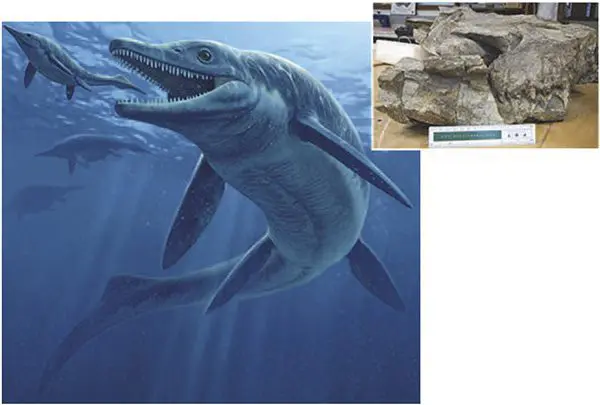
| Credit: Raul Martin/© National Geographic Magazine; (inset) (inset) Jörg Fröbisch/Museum für Naturkunde, Berlin |
| Science.org 7 Jan 2013 |

Rise of the Titans
The sauropods were the biggest creatures ever to walk the planet. But the keys to their success emerged in…

Finding Fossils Faster
SAVING HISTORY: Paleoanthropologists Meave Leakey (left) and daughter, Louise (right), examine a fossil…

Caveful of Clues about Early Humans
“Field research” projects often require scientists to endure discomfort and danger to get…

Was the First Craniate1 on the Road to Cognition?
Chinese fossil discoveries of the earliest known craniates (from the early Cambrian period) have led…

A Little Fish Challenges a Giant of Science
Taiwanese biologist Chia-Wei Li has been working with paleontologist Jun-Yuan Chen…

Religion Has Nothing to Fear from NASA
This Saturday, NASA will launch a small spacecraft in hope of getting answers to…

Rebuilding Greensburg Green
Everyone assumed this Kansas town was destined to fade away. What would it take…

The First Sea Monster
Researchers have announced the discovery of the first sea monster (artist’s impression above)—an…

How Giants Conquered the Earth
How did animals the size of a goat evolve into the largest creatures on Earth? The…

Cave Diving for Europe’s Past
Four years ago, Romanian explorer Stefan Milota made an amazing discovery in…

Paleontologic Agitprop?
Before smiling officials escorted an international group of foreign scientists to…

Making the Sale
It was that Presbyterian biologist who almost blew the sale. And not only a sale to the Presbyterians, but…

The Rebuilder’s Tale
I wanted to make a difference. After earning my Ph.D. in engineering in 2002 at Baghdad University…

Home Alone in the Universe?
As I first learned at a dinner table surrounded by new acquaintances, questioning someone’s belief in extraterrestrial intelligence…
Articles
Rise of the Titans
Finding Fossils Faster
Caveful of Clues about Early Humans
Was the First Craniate on the Road to Cognition?
A Little Fish Challenges a Giant of Science
Religion Has Nothing to Fear from NASA
Rebuilding Greensburg Green
The First Sea Monster
How Giants Conquered the Earth
Cave Diving for Europe’s Past
Paleontologic Agitprop?
Making the Sale
The Rebuilder’s Tale
Home Alone in the Universe?